Chapter 21 · The Real Constitution
The Microcosm-Macrocosm Principle
The Microcosm-Macrocosm principle has ancient origins, appearing across diverse philosophical and spiritual traditions. The idea that the individual reflects the universe appears across traditions. The phrase "Yat Pinde tat Brahmande" reflects the belief that the human body (pinda) contains the same elemental forces and cosmic order as the universe (Brahmanda).
This synthesis of philosophy and science suggests that we are not just in the universe, we are the universe, replicated at every scale. This idea is echoed in the Upanishads, which describe the individual soul (Atman) as identical to the universal soul (Brahman). The Mundaka Upanishad (3.1.7) states,
बृहच्च तद् दिव्यमचिन्त्यरूपं सूक्ष्माच्च तत् सूक्ष्मतरं विभाति ।
दूरात् सुदूरे तदिहान्तिके च पश्यन्त्विहैव निहितं गुहायाम् ॥ ७॥
"That Brahman shines forth, vast, self-luminous, inconceivable, subtler than the subtle. He is far beyond what is far and yet here very near at hand. Verily, He is seen here, dwelling in the cave of the heart of conscious beings." The Self (Atman) is the same as the supreme Brahman or microcosm, and the macrocosm is one. By knowing as much about the numerical forces of the cosmos, their attributes, and their correlation, we can also learn about ourselves and our purpose. The true meaning is reflected by the following Yoga-kundalini Upanishad shloka 1.81.
पिण्डब्रह्माण्डयोरैक्यं लिङ्गसूत्रात्मनोरपि ।
स्वापाव्याकृतयोरैक्यं स्वप्रकाशचिदात्मनोः ॥
Realise the oneness of the Viswa-atman (cosmic soul) through Turiya (a state of Samadhi) of the microcosm (body), with the Virat-atman (great soul) through the Turiya of the macrocosm. Realise the Linga with the Sutraman, of sleep with the unmanifested state, self-illumination of the Atman manifested in one's self, with the Atman of consciousness. The Brihadaranyaka Upanishad (1.4.10) mentions.
ब्रह्म वा इदमग्र आसीत्, तदात्मानमेवावेत् ‘अहं ब्रह्मास्मि’ इति । तस्मात् तत् सर्वमभवतद्यो यो देवानां प्रत्यबुध्यत स एव तदभवत्तथर्षीणां तथा मनुष्याणां तद्धेतत्पश्यन्नृषिर्वामदेवः प्रतिपेदेऽहं मनुरभवं सूर्यश्चेति । तदिदमप्येतर्हि य एवं वेदाहं ब्रह्मास्मीति स इदं सर्वं भवति तस्य ह न देवाश्चनाभूत्या ईशते । आत्मा ह्योषां स भवत्यथ योऽन्यां देवतामुपास्तेऽन्योऽसावन्योऽहमस्मीति न स वेद तथा पशुरेवं स देवानाम् । यथा ह वै बहवः पशवो मनुष्यं भुञ्जयुरेवमेकैकः पुरुषो देवान्भुनक्त्येकस्मिन्नेव पशावादीयमानेऽप्रियं भवति किमु बहुषु तस्मादेषां तन्न प्रियं यदेतन्मनुष्या विद्युः ।
This self was indeed Brahman in the beginning. It knew only Itself as ‘I am Brahman’. Therefore, it (self) became all. And whoever among the gods knew it also became That; and the same with sages and men. The sage Vamadeva, while realising this (self) as That, knew, ‘I was Manu, and the sun’. And to this day, whoever in like manner knows it as, ‘I am Brahman’, becomes all this (universe). Even the gods cannot prevail against him, for he becomes their self. While he who worships another god, thinking, ‘He is one, and I am another’, does not know. He is like an animal to the gods. As many animals serve man, so does each man serve the gods. Even if one animal is taken away from man, it causes anguish; what should one say of many animals? Therefore, it is not liked by them that men should know this.
Similarly, in ancient Greek philosophy, Plato’s Timaeus portrays the cosmos as a living being with a soul, suggesting that human beings are microcosmic reflections of this greater whole. The Hermetic tradition, emerging from Hellenistic Egypt, further popularised this concept with the axiom "As above, so below.". The Emerald Tablet declares, "That which is below is like that which is above, and that which is above is like that which is below, emphasising the correspondence between the individual and the universal.
Historically, this principle has influenced fields such as astrology, alchemy, and medicine. For example, the Renaissance physician Paracelsus argued that human health depends on aligning the microcosm of the body with the macrocosm of the heavens (Paracelsus, Paramirum). These traditions view the human being as a miniature universe, containing the same elements—earth, water, air, fire—and principles that govern cosmic order. This interconnectedness implies that understanding the self can reveal truths about the universe, and vice versa. It also means that there are parallels between individual consciousness and collective behaviour, and contemporary research also supports this analogy.
Fractal Geometry Natural systems exhibit self-similarity, where small structures resemble larger ones. Self-similarity across scales exists from cells to galaxies.
Systems Biology (Noble, 2006), "The organism is a society of cells, and its behaviour is an emergent property of their interactions." The human body operates as a network of interdependent systems, much like ecosystems or galaxies.
Consciousness Studies (Tononi & Koch, 2015) Integrated Information Theory (IIT) suggests that consciousness arises from the complexity of interactions, applicable to both brains and potentially larger systems.
The Universe Story. “That the universe is a communion of subjects rather than a collection of objects is the central commitment of the Ecozoic. Existence itself is derived from and sustained by this intimacy of each being with every other being of the universe.”
Collective Behaviour as a Macrocosmic Reflection
Just as individuals have a body and consciousness, groups of people—whether in companies, societies, or nations—act as collective entities with a unified "combined thought." This analogy aligns with the Microcosm-Macrocosm principle by positing that social structures mirror the organisation of the individual. For instance, a company, legally recognised as an artificial person, exhibits behaviours and decisions that emerge from the collective actions of its employees, yet it takes on an identity distinct from any single member. Research in organisational psychology shows that groups develop shared cognition, leading to emergent behaviour not reducible to individual actions.
Similarly, in the United Nations, countries are treated as individual actors, each with its policies, interests, and "personality," despite being composed of millions of citizens.
The collective entities are macrocosmic bodies, with individuals functioning as their constituent parts, much like cells in a human body.
Research in organisational psychology and swarm intelligence supports collective decision-making and emergent group cognition.
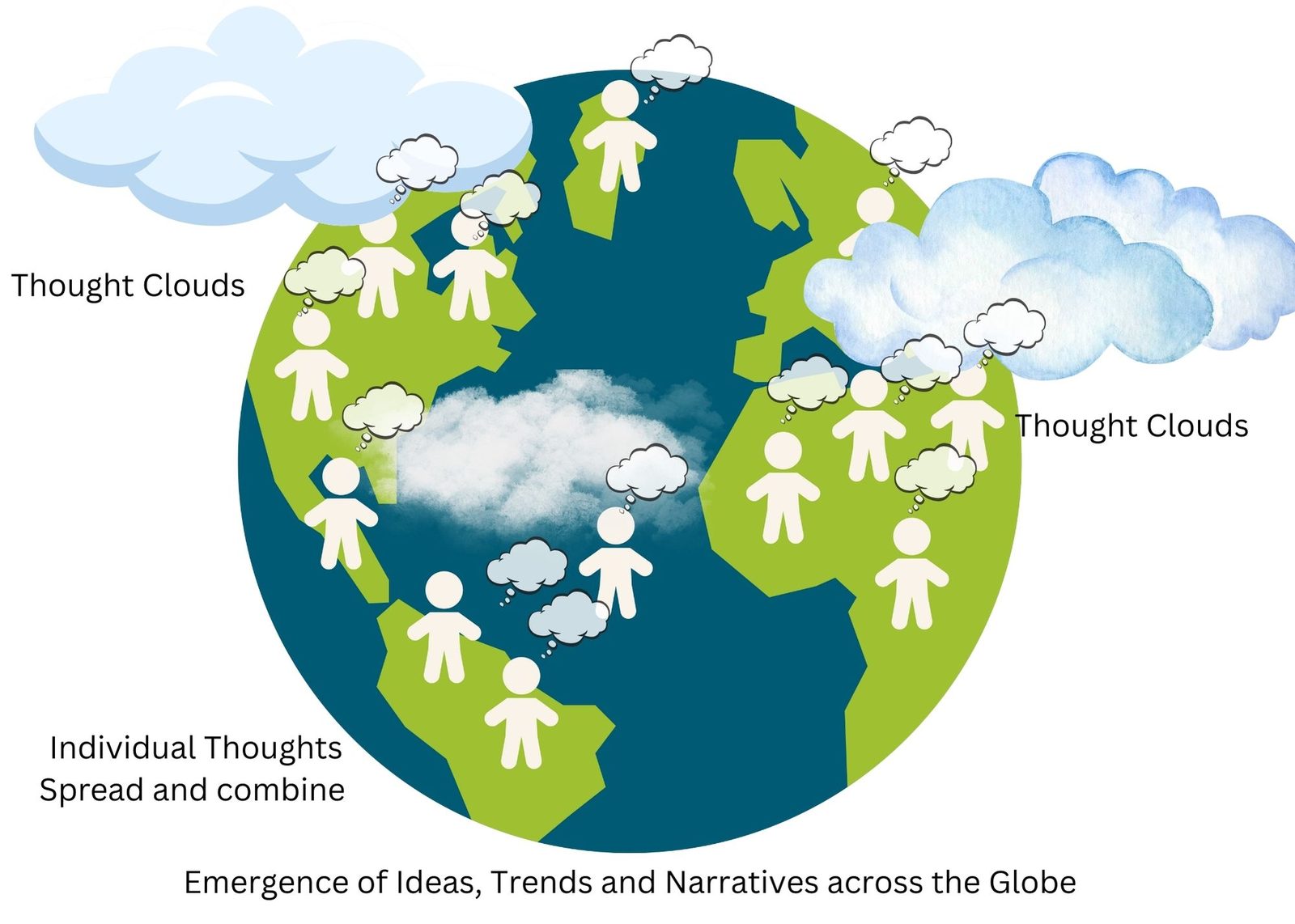
High-Reliability Organisations (e.g., aircraft carriers) develop a shared cognition where the group 'thinks' as a unit."
Swarm Intelligence: "Ant colonies exhibit problem-solving abilities that no single ant possesses, demonstrating distributed intelligence."
Social Brain Hypothesis (Dunbar, 1998): Human societies function like neural networks, where interactions create a larger "mind."
The Noosphere (Teilhard de Chardin, 1955): Teilhard’s concept of a global thinking layer, "The noosphere is the collective mental envelope of humanity, evolving towards a single conscious network."
Collective Consciousness Theory. Émile Durkheim, a foundational sociologist, introduced the concept of "collective consciousness," describing it as the set of shared beliefs, attitudes, and values that unify a society. Durkheim argued that this collective consciousness transcends individual minds, shaping social norms and behaviours in ways analogous to how personal consciousness guides an individual’s actions.
Holons and Systems Theory: To deepen this exploration, we can draw on Arthur Koestler’s concept of "holons,". A holon is an entity that is simultaneously a whole and a part—for example, an individual is a complete person yet also a component of a larger group, such as a company or nation. Koestler’s framework aligns with the Microcosm-Macrocosm principle, suggesting that each level of organisation reflects similar patterns of structure and behaviour. A nation, as a macrocosmic holon, comprises microcosmic holons (individuals), and its collective behaviour emerges from their interactions.
Systems theory further illuminates this relationship by examining how complex systems function through the interplay of their components. In social systems, individuals (microcosms) are nested within larger systems (macrocosms), such as organisations or societies. According to Ludwig von Bertalanffy, the founder of general systems theory, "a system is characterised by the interactions of its components and the nonlinearity of those interactions". This perspective highlights how the behaviour of a collective entity, like a company or nation, arises from the dynamic relationships among its members, mirroring the emergence of individual consciousness from neural interactions.
Carl Jung’s The concept of the collective unconscious offers a lens for understanding how shared mental structures influence group behaviour psychologically. Jung described the collective unconscious as a reservoir of archetypes and experiences inherited by all humans, shaping both individual and collective actions. This shared psychic framework can be seen as a form of collective consciousness that guides the decisions and identity of groups, reinforcing the Microcosm-Macrocosm analogy.
In companies, this manifests as organisational culture—the shared values, norms, and practices that define a firm’s "personality." Research by Edgar Schein demonstrates that organisational culture emerges from the collective behaviour of employees but also shapes their actions in return, creating a feedback loop akin to an individual’s personality development. For example, a company like Google fosters a culture of innovation, which influences employee creativity while reflecting the collective ethos of its workforce.
National Identity as a Macrocosmic Personality
At the level of nations, the concept of national identity parallels the idea of a collective personality. Nations are often characterised by shared values, historical narratives, and cultural traits that define their behaviour on the global stage. Benedict Anderson’s Imagined Communities (1983) describes nations as socially constructed entities, where citizens imagine themselves as part of a unified whole despite never meeting most of their compatriots. This imagined unity creates a national character, such as resilience in Japan or individualism in the United States, that functions as a macrocosmic reflection of individual traits.
In international forums like the United Nations, countries act as if they were persons, negotiating, forming alliances, and pursuing goals. A study by Hofstede on cultural dimensions reveals how national cultures influence collective behaviour, with traits like collectivism or power distance shaping governance and societal norms. Thus, nations can be seen as macrocosmic entities mirroring the structure and consciousness of individuals. There are studies on anthropomorphism in international relations, and there are states often personified in diplomacy.
Robert Axelrod (1984) in The Evolution of Cooperation: "Nations, like individuals, engage in tit-for-tat strategies, suggesting they 'learn' from interactions." (p. 73).
Kenneth Waltz (1979) in Theory of International Politics: "States behave like unitary rational actors in an anarchic system, akin to individuals in a Hobbesian state of nature."
State Personification: The U.S. is "Uncle Sam," Russia is the "Bear," etc. This is not just a metaphor but reflects how nations act with agency.
Game Theory & IR (Axelrod, 1984): Nations behave strategically, akin to individuals in a social dilemma.
A New World Order. Global governance is a networked brain, where states, NGOS, and corporations interact like neurons.
UN as a Global Sensorium. The UN Security Council functions like a prefrontal cortex, regulating conflicts through collective decisions.
Nations and Microcosm
The design of a nation should reflect the balance and harmony found in a microcosm. In Plato’s Republic, the ideal state mirrors the tripartite soul—reason, spirit, and appetite—corresponding to rulers, warriors, and producers, respectively, to ensure societal harmony. Similarly, Confucian thought likens the state to a family, with the ruler as a moral exemplar fostering order and unity (Confucius, Analects).
The parallels between individuals, groups, and nations suggest a deep structural symmetry in how consciousness and organisation manifest across scales. Interdisciplinary insights from systems theory, neuroscience, and sociology support the notion that human collectives behave as super-organisms. In modern terms, configuring a nation like a person means structuring governance to balance economic, social, and environmental priorities, much like an individual balances mind, body, and spirit. Research on sustainable development advocates for holistic policies that integrate diverse societal functions. Participatory governance, where citizens contribute to decision-making like cells in a body, could enhance this balance.