Chapter 7 · Criticism of European Ideas
Democratic Republic
Jawaharlal Nehru in the fifth sitting of the Constituent Assembly debate on December 13, 1946, said, “What else can we have in India? Whatever the States may have or may not have, it is impossible and inconceivable and undesirable to think in any other terms but in terms of the Republic in India.” Consequently, India celebrates the Republic Day on 26th January every year, showcasing military might, culture and scientific achievements with a great fanfare.
We see the above two words in our Preamble, ‘Democratic Republic’. What is a Republic? Despite the widespread usage of this name, very few understand its real meaning. A detailed account of the Republic is available in a later chapter. A brief introduction of the Republic is as follows.
Plato's "The Republic" (380 BCE) explores profound questions about justice, governance, morality, and the ideal society. "The Republic" is an attempt to define what constitutes a just society and a just person. It introduces the concept of an ideal philosopher-king, arguing that guardians should possess wisdom, virtue, and a deep understanding of the world. There are many forms of governance; some of these are described below.
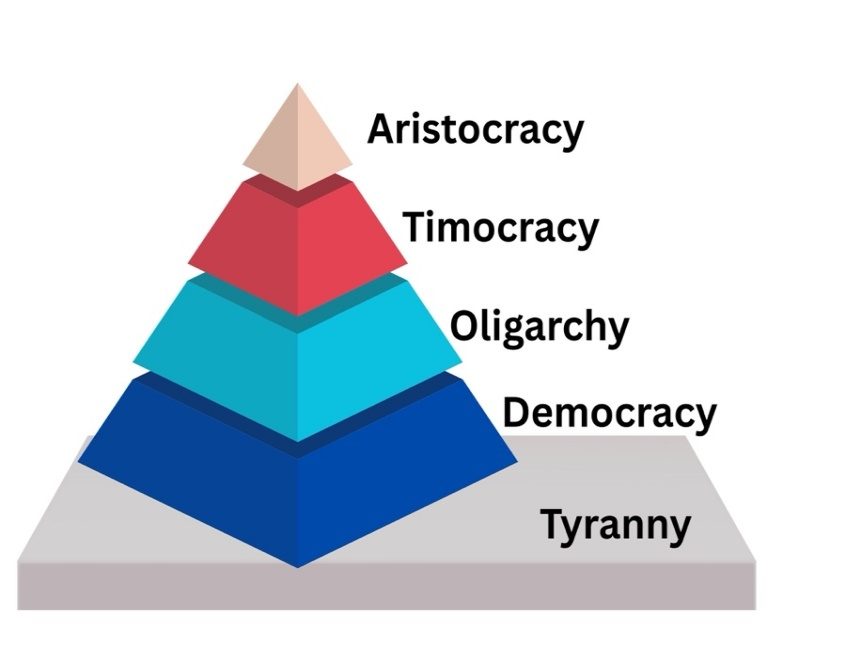
Forms of Governance in Plato's Republic and Their Order of Merit
The Ideal Republic - Kallipolis. This is Plato’s ideal state, ruled by philosopher-kings who possess wisdom and prioritise the common good over personal interest. This is also known as the Aristocracy. It features a tripartite class structure (rulers, auxiliaries, producers) harmonised for justice. The guardians possess no private property or family to eliminate corruption. It is considered the pinnacle of governance, achieving justice through the rule of the wise and virtuous, ensuring harmony and the well-being of all citizens. Its success depends on the incorruptibility of philosopher-kings and the success of education. Plato suggests it can decline if guardians fail to maintain wisdom or if breeding and education falter (546a, 547a), leading to the "noble lie" losing its hold and class divisions weakening.
Timocracy is a government ruled by honour-loving warriors (auxiliaries), emerging when guardians prioritise ambition and prestige over wisdom. It resembles Sparta, valuing military prowess and honour over philosophical insight. In military and sports, which have winners and achievers, this system is more suitable. It retains some virtues such as discipline and courage. But lacks the intellectual foundation of philosopher-kings. The obsession with honour and status leads to rivalry and instability. Rulers neglect the common good, focusing on personal glory, and the state becomes militaristic and competitive. Wealth begins to creep in as a secondary value, sowing seeds for further decline.
Oligarchy is the rule by the wealthy few, where power is based on property ownership. It arises when Timocrats’ pursuit of honour shifts to accumulating riches, excluding the poor from governance. It maintains order through the self-interest of the rich but sacrifices broader societal harmony. Greed and inequality define this system. The rich oppress the poor, creating a divided society with “two cities”—one of the wealthy, one of the destitute. This breeds resentment and potential rebellion, as the poor are marginalised and the rulers prioritise wealth over virtue.
Democracy is the rule by the people, emerging when the poor overthrow the oligarchs, establishing freedom and equality as core principles. It is characterised by diversity, liberty, and the pursuit of individual desires. It offers freedom and equality, appealing to the masses, but lacks the discipline and wisdom of higher forms. Excessive freedom leads to chaos and license. Citizens pursue base desires without restraint, undermining authority and order. The lack of a unifying moral vision makes it vulnerable to manipulation by demagogues, paving the way for tyranny.
Tyranny is the rule by a single tyrant, arising when a democratic leader or military seizes absolute power to satisfy personal appetites. It is the ultimate degradation of governance, marked by oppression and fear. It is the furthest from justice, serving only the tyrant’s whims and enslaving the populace. Tyranny is defined by cruelty, paranoia, and instability. The tyrant, driven by insatiable desires, distrusts everyone, isolates himself, and rules through violence, making his life miserable and the state a prison for its citizens.
Aristocracy aligns with reason, Timocracy with spirit, Oligarchy and Democracy with appetite, and tyranny with its most disordered form. Plato’s conviction that only wisdom can sustain justice, positioning the Republic’s vision as a unique and superior governance model. In comparison with above India had the following systems.
Atreya Brahman has described five types of administrative polities, viz. Samarajya, Bhojya, Swarajya, Vairajya and Rajya. In the Samrajya polity, the head of the state was called Samrat; his coronation was a necessity, and his position was hereditary. In the Bhojya polity, the head of the state was called Bhoja, and his status was not hereditary; rather, he was assigned administrative authority for a fixed period. The Satvava Yadavas, too, had this sort of polity. In the Swarajya polity, the head of the state was called Samrat, and its administration was carried on by some respected Kulas, which were regarded as equal to each other. In the Vairajya polity, the head of the state was called the king. The representatives of the people chose different administrative officers as well. In Rajya polity, tribal administration continued as before. The Janpadas of Kuru and Panchal in Madhyadesh pursued this system. Most of the contemporary texts have referred to the Samrajya polity, where the head of the state was called the Samrat and whose office was hereditary. Rig Veda lays down the qualities of a king.
स घाराजासत्पतिः शूशुवज्जनोरातहव्यः प्रति यः शासमिन्वति।उक्थावा योअभिगृणातिराधसादानुरस्माउपरापिन्वतेदिवः।। - ऋग्वेदमन्त्र 1.54.7
He is certainly the King, the regulator of life, illuminated by the analytical wisdom, which is:-
(a) Satpatih - the guardian of truth
(b) Shushuvat janah - a person capable of evolving himself
(c) Ratahavyaḥ - the giver of sacrifices
(d) Prati shasam invati - widely following the rule and Dharma
(e) Uktha Abhigrunati Radhasa - preaches divine instructions to everyone to benefit all.
(f) Danuh asma upara pinvate divah - God gives high divine knowledge to such people.
Every Raja has the Raj Dharma to follow; it represents a holistic vision of governance, where the king, as a "controller" rather than a ruler, acted as a patriarch with a divine representative. Whether elected or hereditary, his duties—protection, justice, welfare, moral leadership, and spiritual stewardship—bound him to serve his people and uphold Dharma. The Suryavanshi tradition started from Vivasvat Manu, who is the son of the Sun god and similarly, the tradition of Chandravanshi Rajas. The best form of governance in India is known as Ramrajya, enriched by examples of Rama. Whereas Trishanku, despite being a legal heir, was rejected due to his actions. The kingship was a sacred responsibility, contingent on virtue and accountability. Though rooted in ancient India, Raj Dharma’s emphasis on ethical leadership and service offers timeless lessons for governance today.
A Republic is a completely different form of governance as compared to the Democracy. Is it possible to have a democratic republic together? As a concept, No. It is possible to have democracy at lower level to ensure representation of the masses and have a Republic in the higher echelons. Now, let’s examine if Indian government has any of the following characteristics.
Philosopher-Kings: Rulers are selected for their wisdom and knowledge of eternal truths, understanding of the Good, the highest Form. They are compelled to govern despite reluctance (indicating they are not power hungry).
Class Division by Nature: Society is divided into three classes: rulers (gold, philosopher-kings), auxiliaries (silver, warriors), and producers (bronze/iron, artisans and farmers), based on natural abilities rather than birth or wealth, reinforced by the "noble lie" to maintain order.
Communism for Guardians: The guardian classes (rulers and auxiliaries) live without private property, sharing wives and children to eliminate personal ambition and corruption.
Education is tightly controlled to identify and nurture individuals for their class, with censored reading lists ensuring only morally uplifting content.
Eugenics: Selective breeding is used for the guardian class to ensure the best leaders.
Psychological Harmony: Justice in the state mirrors the individual's soul, with reason (rulers), spirit (auxiliaries), and appetite (producers) corresponding to each class, ensuring psychological harmony (Plato: middle period metaphysics and epistemology). This integration of psychology and politics is uncommon.
No Gender Bias in Leadership: Women can be guardians and receive equal education, progressive for its time.
While comparing with the above characteristic, except for the participation of women, we can conclude that the Indian governance system can not be termed as a Republic. India is a modified democratic system, and it is very unlike the ancient democratic system, which was prevalent in Greece and Rome. Democracy is derived from the Greek words "demos" (people) and "kratos" (power or rule). It signifies a system of governance where power lies with the people.