Chapter 4 · Constitution of India
A Historical Perspective on India's Constitution
The Constitution of India, the supreme law of the land, is a testament to the collective will of a newly independent nation. It was adopted on January 26, 1950. It is the supreme legal framework governing the world's largest democracy. It aims to reflect the aspirations, values, and diversity of a nation emerging from colonial rule.
Early Thoughts and Influences
The idea of a constitution for India began to take shape during the British colonial period. The first significant step was the Regulating Act of 1773, which marked the beginning of parliamentary control over the East India Company.. This was followed by several other acts, such as Pitt's India Act of 1784, Charter Acts of 1813, 1833, and 1853, and the Government of India Acts of 1858, 1919, and 1935. These acts laid the groundwork for constitutional governance in India by introducing various administrative and legislative reforms.
Formation of the Indian National Congress
The genesis of the Indian Constitution can be traced to the late 19th century, with the formation of the Indian National Congress. The primary organisers included Allan Octavian Hume, a retired British civil servant, and Indian leaders such as Dadabhai Naoroji, Surendranath Banerjea, and Pherozeshah Mehta. Hume is often credited with initiating the Congress by writing an open letter in 1883 to Calcutta University graduates, calling for a national political movement. The first session, attended by 72 delegates, aimed to promote Indian interests and foster dialogue with the British Raj.
INC was founded on December 28, 1885, with its first session held at Gokuldas Tejpal Sanskrit College in Bombay, attended by 72 delegates, including social reformers, journalists, and lawyers. The initiative was driven by a growing discontent with British policies and a desire for greater Indian involvement in governance. The Congress initially focused on moderate reform, seeking greater political autonomy within the British Empire, rather than immediate independence.
Madam Blavatsky and the Theosophical Society
Helena Petrovna Blavatsky, a Russian mystic and co-founder of the Theosophical Society, moved to India in 1879 and spent significant time there until she died in 1891. Her work with the Society contributed to the nationalist discourse. Blavatsky's promotion of Indian spiritual heritage, through writings like "Isis Unveiled" and "The Secret Doctrine," helped revive interest in Hindu philosophies, which indirectly supported the cultural awakening that fueled nationalism.
A pivotal aspect of Blavatsky's early life was her vision of a "mysterious Indian.", whom she later identified as Master Morya, one of the Mahatmas in Theosophical belief. According to A.P. Sinnett's "Incidents in the Life of Madame Blavatsky," published in 1886, she began experiencing these visions in childhood, describing the figure as a tall, dark man with piercing eyes and a commanding presence. She claimed he was her protector and guide, telling her she had great work to do in the world, which required preparation through study and learning.
This vision was not a one-time event but a recurring theme, with Blavatsky asserting that she met this figure in person in 1851 in London, further solidifying her belief in his guidance. This encounter, she claimed, was a fulfilment of her childhood visions, inspiring her to embark on a quest for ancient wisdom, particularly in India.
Inspired by her vision, Blavatsky travelled extensively, visiting Europe, the Americas, and eventually India in 1879, after founding the Theosophical Society in New York in 1875. Her journey to India was driven by the desire to reconnect with Master Morya and to study under the spiritual adepts she believed resided there, particularly in Tibet. The Society's objectives, including promoting universal brotherhood and studying comparative religion, were influenced by her belief in the teachings of the Mahatmas, with Master Morya and Koot Hoomi being primary guides.
Master Morya could either be Chandragupta Maurya of the Maurya Empire whose mentor was Chanakya (Kautilya) or Samprati Maorya his great grandson. Chandragupta’s reign, marked by military expansion and administrative reforms, saw the empire extend across much of the Indian subcontinent, from Bengal and Assam in the east to Afghanistan and Balochistan in the west. His rule is documented in the Arthashastra.
According to Digambara Jain accounts, Chandragupta abdicated his throne and settled as a monk under Bhadrabahu, a prominent Jain saint, in Shravanabelagola, located in present-day Karnataka. These accounts, found in texts like the Brihakathā kośa (931 CE) by Harishena and the Bhadrabāhu charita (1450 CE) by Ratnanandi, suggest that Bhadrabahu forecasted a 12-year famine due to the violence of Chandragupta's conquests, prompting their migration south. Chandragupta is said to have lived ascetically at Shravanabelagola, performing Sallekhana, a ritual of fasting to death, which he completed around 297 BCE, marking his final days. The hill where he practised asceticism is now known as Chandragiri hill, and a surviving temple, Chandragupta basadi, stands there, reinforcing the Digambara tradition.
Blavatsky's vision of Master Morya was not just a personal mystical experience but a catalyst for her life's work. It led her to India, where she sought to bridge Eastern and Western esoteric traditions, influencing the Theosophical Society's growth and its impact on Indian national consciousness, as acknowledged by figures like Gandhi and Nehru..
Blavatsky's teachings and the society's emphasis on Indian spirituality and culture inspired many Indian intellectuals and reformers. Allan Octavian Hume, a member of the Theosophical Society, was influenced by its ideals and sought to apply them to the political realm.
The Founding Spirit Allan Octavian Hume
Allan Octavian Hume, a retired British civil servant, is widely regarded as the principal founder of the Indian National Congress. Hume's vision was to create a platform for civil and political dialogue among educated Indians. He believed that such an organisation could help bridge the gap between the British rulers and the Indian populace[1]. Hume's efforts culminated in the first session of the INC., held on December 28, 1885, at Gokuldas Tejpal Sanskrit College in Bombay, with 72 delegates in attendance.
Annie Besant, a prominent theosophist and social reformer, joined the Indian National Congress in the early 20th century and became one of its most influential leaders. Although she was not directly involved in the founding of the INC, her contributions to the Indian independence movement were significant. Besant's involvement with the Theosophical Society brought her to India, where she became a vocal advocate for self-rule and social reforms. In 1917, she became the first female president. Of the INC, she used her platform to push for greater political rights for Indians.
A prominent Indian nationalist and economist, Dadabhai Naoroji was one of the founding members and later became the president of the second session in 1886. His economic critiques, such as the "drain theory," highlighted British exploitation, aligning with Congress's objectives. Surendranath Banerjea and Pherozeshah Mehta were two influential leaders who contributed to the early organisational efforts, with Banerjea being a founder of the Indian Association and Mehta a key figure in Bombay's political circles.
The Role of the Theosophical Society
The Theosophical Society, established in 1875 in New York by Helena Blavatsky and Col Henry Steel Olcott, gained traction in India by 1879, with its headquarters set up in Adyar, near Madras, in 1882. The Society's objectives included promoting universal brotherhood, studying comparative religion, and investigating occult laws, which resonated with Indian intellectuals seeking to revive national pride and cultural identity.
AO Hume, serving as vice-president from 1880 to 1888, leveraged the Society's network to connect with Western-educated Indians and liberal Britons, fostering cooperation at an all-India level. The Society's emphasis on neo-Hinduism and spiritual revival gave nationalists confidence and organisational experience, which likely aided Hume's efforts.
The idea for an all-India Congress was conceived at a private meeting after the 1884 Theosophical Convention in Adyar, highlighting the Society's indirect influence. The Society's emphasis on universal brotherhood and comparative religion likely provided a philosophical backdrop for nationalist ideas, though historians debate its direct impact.
The society's emphasis on Indian culture and spirituality helped foster a sense of national pride and unity among Indians.. Theosophy provided a framework for Indian intellectuals to articulate their aspirations for self-governance and social reform. The society's activities also helped create a network of like-minded individuals who would later become prominent leaders in the Indian independence movement.
Initial Struggles
Initially, the Congress focused on demanding greater representation for Indians in legislative and executive bodies under British rule. This period saw the Morley-Minto Reforms of 1909, which introduced separate electorates for different communities, and the Montagu-Chelmsford Reforms of 1919, enacted through the Government of India Act, 1919. These reforms provided for a bicameral central legislative body and some provincial autonomy, but they were seen as inadequate by Indian nationalists, who sought more substantial self-governance.
The Non-Cooperation Movement, launched in 1920 under Mahatma Gandhi, further intensified demands for swaraj (self-rule), setting the stage for more assertive constitutional discussions. These early efforts laid the groundwork for future constitutional developments, reflecting the growing nationalist sentiment.
The Simon Commission and the (Motilal) Nehru Report 1929
A pivotal moment came with the appointment of the Simon Commission in 1927 to review the workings of the 1919 Act. The commission, lacking Indian members, faced widespread boycotts, prompting Indian leaders to respond with the Nehru Report of 1928. Drafted by a committee chaired by Motilal Nehru, with Jawaharlal Nehru as secretary, the report proposed dominion status for India within the British Commonwealth, a parliamentary system, and joint electorates with reserved seats for minorities. This was a significant step, as it was the first major attempt by Indians to outline a constitutional framework, drawing from the American Bill of Rights and advocating for universal adult suffrage and equal rights for women.
Round Table Conferences and the Government of India Act, 1935
The Round Table Conferences, held from 1930 to 1932, were a series of meetings organised by the British government to discuss constitutional reforms. The first conference (November 1930–January 1931) saw limited participation from the Indian National Congress due to the Civil Disobedience Movement, but subsequent conferences, including the second (September–December 1931) with Gandhi’s participation, highlighted the need for a federal structure (Round Table Conferences (India)). These discussions led to the Government of India Act of 1935, which was the longest act passed by the British Parliament at the time, with 321 sections and 10 schedules (Government of India Act 1935). It introduced a federal system, provincial autonomy, and the establishment of the Reserve Bank of India and a Federal Court, though it retained significant British control.
World War II and the Cripps Mission
The outbreak of World War II brought new urgency to constitutional discussions. The Cripps Mission, sent in March 1942 under Sir Stafford Cripps, aimed to secure Indian cooperation for the war effort by offering dominion status post-war and the formation of a Constituent Assembly (Cripps Mission). However, the proposals were rejected by both the Congress and the Muslim League, leading to the Quit India Movement, which demanded immediate independence. This failure underscored the deepening divide between Indian leaders and the British, pushing the constitutional process further.
The Constitution not only establishes the structure of governance but also embodies a profound philosophical vision rooted in justice, liberty, equality, and fraternity. The Constitution of India is a symbol of the nation's sovereignty, its commitment to people and their aspirations for a better future. It has served as a guiding light for India's journey as an independent nation, shaping its political, social, and economic landscape.
The Genesis of the Constituent Assembly
The seeds of the Indian Constitution were sown during the struggle for independence. Leaders of the national movement, recognising the need for a framework to govern a free India, began envisioning a constitution that would embody the ideals of self-rule, democracy, and social justice. In 1946, the Cabinet Mission Plan paved the way for the formation of a Constituent Assembly, tasked with drafting a constitution for independent India.
The Constituent Assembly, composed of representatives from across the country, was a microcosm of India's diverse population. It included eminent jurists, political leaders, social reformers, and representatives from various communities and regions. The Assembly's composition reflected the nation's pluralistic character, ensuring that the voices and concerns of all sections of society were heard and considered.
The Guiding Light: The Objectives Resolution
The formation of the Indian Constitution was a historic event, a culmination of the struggles and sacrifices of countless individuals who dreamt of a free and just India.
On December 13, 1946, Jawaharlal Nehru introduced the Objectives Resolution in the Constituent Assembly. This resolution laid the foundation for the Constitution, outlining its philosophy and guiding principles. It declared India a sovereign, democratic republic, guaranteeing justice, liberty, equality, and fraternity to all its citizens. The Objectives Resolution served as a beacon, illuminating the path towards a new India, free from the shackles of colonialism and committed to the welfare of its people.
Formation and Work of the Constituent Assembly
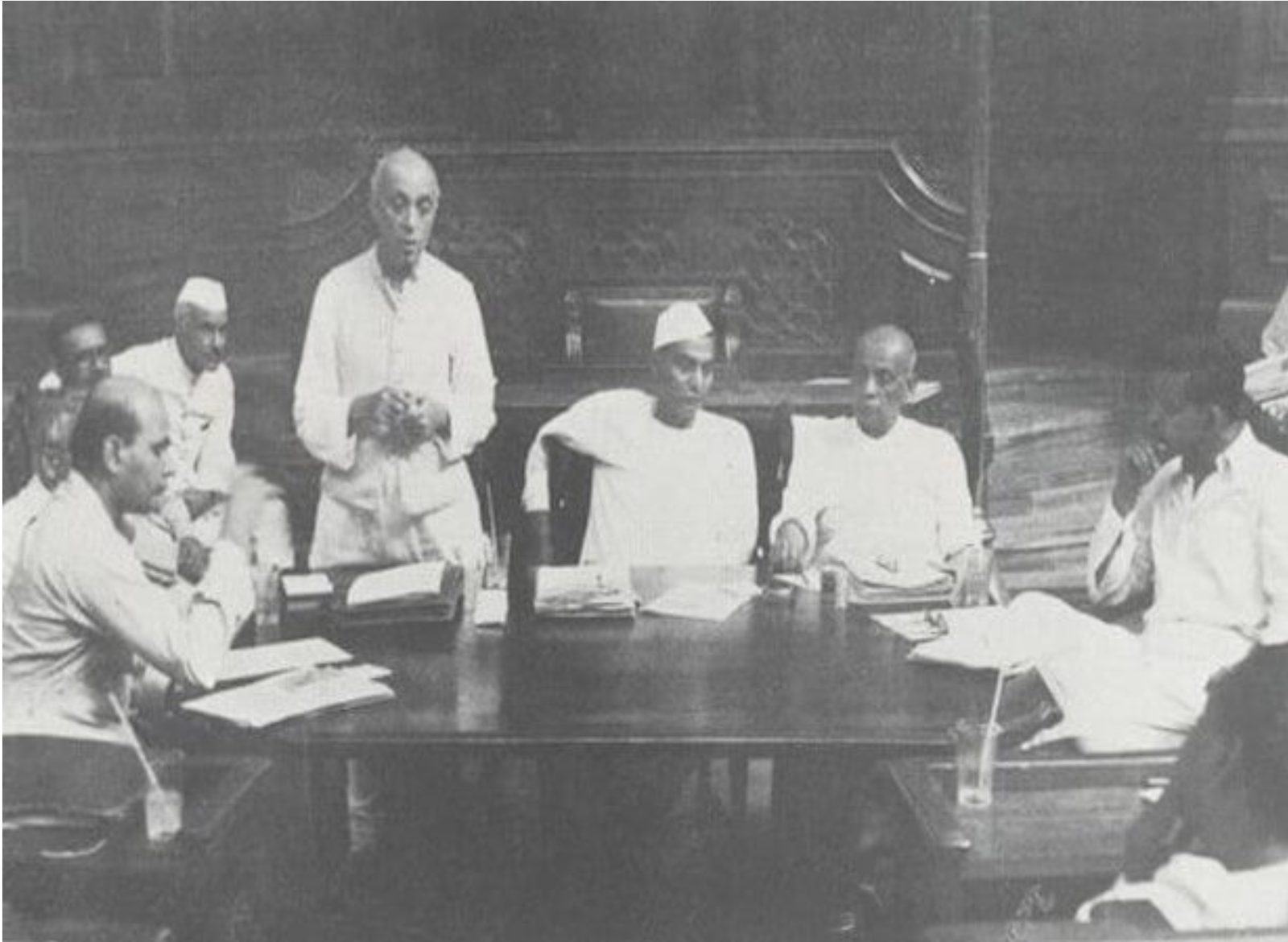
The Constituent Assembly embarked on the challenging task of drafting the Constitution, drawing inspiration from various sources, including the constitutions of other democratic countries. The Constituent Assembly was formed in 1946 based on the Cabinet Mission Plan, with members elected indirectly by Provincial Legislative Assemblies and nominated by Princely States (Constituent Assembly of India). Initially comprising 389 members, the number reduced to 299 after the partition of India in 1947. The assembly held its first session on December 9, 1946, with Dr. Sachchidananda Sinha as the temporary chairman, later replaced by Dr. Rajendra Prasad as President. Dr. B.R. Ambedkar chaired the Drafting Committee, which was tasked with preparing the final draft.
The assembly met for 11 sessions over nearly three years, spending 114 days on the draft constitution. Key committees, such as the Union Powers Committee and the Committee on Fundamental Rights, played crucial roles. The process involved intense debates on federalism, the role of the President, and the protection of minority rights, reflecting the diverse needs of a vast and pluralistic nation.
The drafting process was marked by extensive debates and discussions, with members of the Assembly expressing diverse opinions and perspectives. The framers of the Constitution meticulously examined each article, clause by clause, ensuring that it aligned with the principles of justice, equality, and national unity. The debates in the Constituent Assembly were a testament to the democratic spirit of the newly independent nation, where diverse viewpoints were respected and considered.
Work Done by Various Committees
During their meetings, several committees handled specific aspects of the constitution. The Union Constitution Committee, led by Jawaharlal Nehru, drafted provisions for the central government. The Provincial Constitution Committee, chaired by Vallabhbhai Patel, focused on state government structures. The Fundamental Rights Sub-Committee, under J.B. Kripalani, formulated citizens' rights. The Drafting Committee, headed by B.R. Ambedkar, prepared the final constitution draft based on other committees' reports. Other groups, like the Minorities and Scheduled Tribes Sub-Committees, addressed minority and tribal rights. These committees conducted research, held discussions, and submitted reports, contributing to the 165 days of assembly sessions over three years.
The Drafting Committee, appointed on August 29, 1947, revised B.N. Rau's initial draft (243 articles, 13 schedules) into the final 395 articles and 8 schedules, presented on November 4, 1948.
The process involved clause-by-clause discussions during the second reading, lasting until October 17, 1949, with frequent amendments proposed, though most were rejected. This collaborative effort ensured the constitution reflected India's diverse cultural, social, and political fabric, as led by figures like Nehru, Ambedkar, and Patel.
The committees were advisory and drafting bodies, not legislative entities with the power to enact laws. Their role was to recommend provisions, which the full Constituent Assembly then debated and adopted. The constitution was formally adopted on November 26, 1949, and came into effect on January 26, 1950, marking India's transition to a republic.
During 1946–1949, while the constitution was being drafted, legislative powers rested with the interim government under the Governor General, led by Prime Minister Nehru, operating under the Government of India Act, 1935, and later the Indian Independence Act, 1947. The committees, such as the Rules of Procedure Committee, framed internal rules for assembly functioning, but these were procedural, not legislative enactments.
The committees did not enact any laws during the meetings from 1946 to 1949, focusing solely on constitution-drafting. The financial cost of drafting was 64 Lakh rupees, which may amount to 200 crores on today's date.
The Constitution guarantees fundamental rights to all individuals, irrespective of their caste, creed, or gender. It also makes special provisions for the protection of minorities and marginalised communities, ensuring their social, economic, and political empowerment. The Constitution's emphasis on Inclusivity and accommodation has been instrumental in fostering a sense of belonging and shared citizenship among India's diverse population.