Chapter 10 · Criticism of European Ideas
Liberty, Equality, Fraternity
The French Revolution (1789 -1794) was a period of radical social and political upheaval driven by widespread dissatisfaction with the monarchy, significant social inequalities rooted in the rigid three-estate system of the Ancien Régime, and severe economic hardships.
Economic recession and harvest failures in the late 1780s led to high unemployment and soaring food prices, disproportionately affecting the poor. Beyond financial issues, the lack of political representation, curtailed freedoms of speech and assembly, and oppressive feudal rights contributed to widespread discontent. Enlightenment ideas critiquing traditional structures and scandals like the Affair of the Diamond Necklace also played a role in shaping public opinion and inspiring revolutionary sentiment. The nobility and middle class increasingly opposed the Ancien Régime and the weak rule of King Louis XVI, while peasants suffered under high taxes and feudal oppression, leading to repeated unrest before the revolution.
By 1793, the revolution had entered a radical phase, marked by the execution of King Louis XVI and the rise of the Jacobins. The Jacobins were a radical political group during the French Revolution, initially known as the Society of the Friends of the Constitution. They were named after the Jacobin monastery in Paris, where they met and became influential, especially during the Reign of Terror from 1793 to 1794. Led by figures like Maximilien Robespierre, they pushed for a republic and were responsible for mass executions to eliminate perceived enemies of the revolution.
To protect the revolution from internal and external threats, they implemented extreme measures like suspending civil liberties, using terror, and centralising power in the Committee of Public Safety. This created a climate of fear and repression, which some historians argue was akin to the old regime's tyranny, thus betraying the revolution's democratic aspirations. However, they believed these measures were necessary to save the revolution, not undo it. The financial cost of their policies, such as price controls and rationing, which impacted the economy and contributed to public discontent, eventually led to their fall in 1794.
Evolution of the Motto
The famous slogan of the revolution, Liberty, Equality, Fraternity, originated from Enlightenment philosophy and became a symbol of the movement. The motto of Liberty, Equality, Fraternity was revived in the 1848 Revolution and officially adopted under the Third Republic in 1880. It was inscribed on public buildings and became a core principle of French identity. Other terms were used, such as "la Nation, la Loi, le Roi" (The Nation, The Law, The King), or "Union, Force, Vertu" (Union, Strength, Virtue), a slogan used beforehand by masonic lodges, or "Force, Égalité, Justice" (Strength, Equality, Justice), "Liberté, Sûreté, Propriété" (Liberty, Security, Property), etc.
The Declaration of the Rights of Man and of the Citizen of 1789 defined liberty in Article 4 as follows, “Liberty consists of being able to do anything that does not harm others: thus, the exercise of the natural rights of every man or woman has no bounds other than those that guarantee other members of society the enjoyment of these same rights.”
Liberty: The freedom to act without harming others.
Equality: Equal rights for all citizens, regardless of class.
Fraternity: Unity and brotherhood among people.
Incorporation of Liberty, Equality and Fraternity in the Indian Constitution
The values of the French Revolution were incorporated in the Indian constitution without India facing the issues faced by the French people. The practices in France were due to the prevailing political, social and religious philosophies, and those did not apply to India. The purpose of good governance is to create a stable, prosperous, and fair society where citizens can thrive. Its aims—rule of law (fair laws, reform-centric and with universal applicability), transparency, accountability, efficiency, citizen participation, security, economic prosperity, and welfare of people, animals and the environment.
Liberty
The motto of liberty makes less sense to a democratic, free nation. It is a great motto to drive people towards revolution, that too in a place where there is too much oppression. If a nation is free and democratic then it is already people centric. The Constitution guarantees fundamental rights, such as freedom of speech, religion, and movement, ensuring individual freedoms while balancing them with collective responsibilities. These freedoms are taken from the the United States Declaration of Independence as postulated by John Locke.
John Locke (1632- 1704) was an English philosopher and physician. He postulated that at birth the mind was a blank slate, or ‘tabula rasa’. This is contrary to Cartesian philosophy, based on pre-existing concepts. This is also against the Indian philosophy of Karma and reincarnation. He maintained that we are born without innate ideas, and that knowledge is instead determined only by experience derived from sense perception, a concept now known as empiricism. Locke is often credited for describing private property as a natural right, arguing that when a person—metaphorically—mixes their labour with nature, resources can be removed from the common state of nature. He is widely regarded as the father of liberalism. Locke contributed to social contract theory, the theory of limited representative government and the protection of basic rights and freedoms under the rule of law.
The Constitution of India guarantees fundamental rights to all citizens, including the right to life, liberty, equality, and freedom of expression. It protects against arbitrary arrest and detention. It provides for freedom of conscience and religion. His ideas on natural rights (life, liberty, and property) and government by consent deeply influenced the Constitution's provisions on fundamental rights and popular sovereignty.
Everyone is born free in lawless society unless that liberty is encroached by another, person, system or society. The ideal of liberty feels like that of an entitlement, it should be replaced by the ideal of ‘Shista’(Śiṣṭa) as described in the Vashistha Dharma Sutra. Śiṣṭa is one whose heart is free from (selfish) desire. The behaviour of such a person is Śiṣṭācāra (शिष्टाचार), his being ever ready to do good to others.
Equality
In France at the time of revolution, the First and Second Estates (clergy and nobility), comprising only 2% of the population, enjoyed extensive privileges, including exemption from major taxes, while the Third Estate (peasants, urban workers, and bourgeoisie), representing 98%, bore the heavy tax burden and had minimal political representation. Extreme wealth inequality, a large national debt exacerbated by wars and royal extravagance, and an inefficient tax system further fueled public resentment.
The principle of equality is enshrined in provisions like the abolition of untouchability, the prohibition of discrimination, and the guarantee of equal protection under the law. The Constitution strives for equality of opportunity in matters of public employment. Equality was defined by the Declaration in terms of judicial equality and merit-based entry to government (art. 6), “[The law] must be the same for all, whether it protects or punishes. All citizens, being equal in its eyes, shall be equally eligible to all high offices, public positions and employments, according to their ability, and without other distinction than that of their virtues and talents.”
Some feared that equality could lead to tyranny if forced upon society. Equality was also without distinction other than that of their virtues and talents. That means there will be no other distinction apart from virtues or talent not because of minority status or reservation quota. This aims to propagate the talent and virtues to promote excellence.
The Constitution prohibits discrimination based on religion, race, caste, sex, or place of birth. Equality can overlook individual needs, circumstances, and varying levels of disadvantage or privilege. It can also undermine individual achievements, virtues, talents and contribution towards collective good. The examples of equity are the following.
Giving a poor person subsidised or free education rather than a rich person to help them
Giving someone a taller ladder to reach a tree
Giving someone a ramp to access a space
Providing information in multiple languages.
Equality is a concept that applies differently to non-living things and living beings due to their fundamental differences. Non-living things, such as objects or machines, can often be considered equal based on uniformity in their physical properties or functions. Living beings, however, are dynamic entities shaped by diverse factors like learning, evolution, motivations, mental conditioning, and personal experiences, making equality among them more complex and context-dependent.
To explore this distinction, we can use set theory from mathematics, which provides a framework to categorise entities into sets and examine their relationships based on shared properties.
Non-living things often exhibit uniformity in measurable attributes, such as size, shape, or function, allowing us to define equality straightforwardly. In set theory, equality is often represented through an equivalence relation, which groups elements into equivalence classes where all members are considered equal based on specific criteria. Non-living things lack variability from learning or personal agency. Their properties are static and objective, making equality a simple matter of matching attributes. This is why equality is more pertinent (relevant and applicable) to non-living things.
Example: Electrons, in physics, all electrons in an atom are identical in mass, charge, and behaviour. Within the subset of subatomic particles in ( N ), electrons form an equivalence class where each member is indistinguishable from the others.
Living beings, particularly humans, are far more complex. They evolve, learn, and are influenced by countless variables—biological, psychological, social, and moral. This inherent variability makes equality among living beings less straightforward and often limited to abstract contexts (e.g., equal rights and status) rather than practical sameness. The reasons are given below.
Stages of Learning and Evolution: A scientist has advanced through education, while an illiterate person has not.
Motivations: A businessman seeks profit, while a pauper may prioritise survival.
Mental Conditioning and Variables: A humanitarian is shaped by empathy, while a criminal may be driven by self-interest or desperation.
Let’s explore equality in living beings with examples.
Scientist Vs Illiterate Person: A scientist and an illiterate person differ vastly in knowledge and societal contributions. A scientist cannot be equated to an illiterate person in knowledge or intellectual capacity. Their stages of learning and mental conditioning place them in separate categories.
Businessman Vs Pauper. The two differ in wealth and economic status. A businessman cannot be treated as equal to a pauper in terms of financial capability or social influence. Their motivations and material conditions create a clear divide.
Humanitarian Vs Criminal- A person who serves humanity and a criminal differ in actions and societal impact. A humanitarian cannot be considered equal to a criminal in terms of moral character or contributions to society. Their motivations and actions place them in stark contrast.
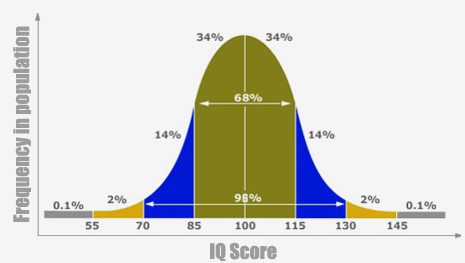
There are some measurable traits in the general population, such as IQ (Intelligence Quotient) and EQ (Emotional Quotient). IQ measures cognitive abilities like reasoning and problem-solving, and its scores are standardised to show about 68% of people between 85 and 115, 95% between 70 and 130, and 99.7% between 55 and 145. Research suggests IQ scores in the general population follow a normal distribution with a mean of 100 and a standard deviation of 15. Image Credits
EQ assesses emotional intelligence, including understanding and managing emotions, and follows a similar distribution based on the EQ-i test. The scores measured by the Bar-On Emotional Quotient Inventory (EQ-i) also follow a normal distribution with a mean of 100 and a standard deviation of 15. Both distributions can be visualised as bell-shaped curves, with most people scoring near the average and fewer at the extremes, implying EQ scores are normed similarly to IQ.
This shows people are not equal in understanding, behaviours, talent, virtues or capacity. There can not be equality of status, yet everyone should be able to participate in governance. Declaring equality in status and rights, without accounting for individual differences in cognitive and emotional capabilities, poses a significant risk to a society that aims to foster excellence, virtue, and innovation. These traits are vital for societal progress, but are not evenly distributed. A blanket approach to equality that ignores these disparities could undervalue excellence, suppress innovation, and allow majoritarianism to overshadow the contributions of a capable minority. Instead, society should balance equal rights with meritocratic systems that identify, nurture, and reward talent, ensuring that those with exceptional potential can thrive while basic opportunities remain accessible to all.
Societies such as Renaissance Europe or modern Silicon Valley often did so by creating environments where exceptional talent was cultivated, not constrained by rigid egalitarian norms. Overemphasising equality in outcomes (rather than opportunities) risks creating a "lowest common denominator" culture, where excellence is neither recognised nor incentivised, leading to stagnation rather than progress. Excellence is not just about IQ or EQ but also about virtues like integrity, empathy, and resilience. A society must promote these qualities alongside raw ability to ensure that leadership serves the collective good, not just personal gain. This argument also fortifies Plato’s concept of the philosopher king. The system should promote the rise of those who have vision, leadership skills, reasoning, creativity, empathy and problem-solving skills.
In essence, while equality in rights is a cornerstone of fairness, it must coexist with mechanisms that elevate and harness excellence. This dual approach ensures that society respects individual differences, promotes virtue, and avoids the pitfalls of majoritarianism, ultimately fostering a dynamic and virtuous community. Equality of status should be as per the individual achievements, virtues, talents and contribution towards the collective good.
Fraternity
The Constitution emphasises the unity and integrity of the nation, promoting a sense of brotherhood among its diverse communities. Fraternity was seen as a moral obligation rather than a legal right, making it the most complex term in the triad. Fraternity can not be ensured because it emanates from the people. When people do good to others, an atmosphere of bonhomie gets created.