Chapter 25 · The Real Constitution
Control of the Reason
The constitution should embody the principles that the government derives its legitimacy from the universal design, its efficacy from the consent of the governed and exists to propagate the greater good. There is a cosmic bond in the cause-and-effect relationship. The reason is higher universal intelligence, which is the foundation of the cosmos. It is also represented by the reasoning and analytical capability of the human mind. As an individual who is able to control one’s behaviour with intellect and plan one’s life, is more successful, so is a nation. It is the implementation of the concept of philosophic king or rule of the wise as mentioned in Plato’s Republic. The wise people are to be selected based on their qualifications, experience, track record and ability to rise for the greater good. These people will undergo further training to become suitable for the role. Selection and election are both processes to form a government by the people.
The word ‘Reason’ is dynamic whereas the word ‘Law’ is static. Control (regulation, flow) is a better word than rule, it stands for regulation or maintaining flow of a nation towards its aims (Purushartha, Paramartha, Parakram, Parisharam and Prem). A system of control of the reason is therefore better than the rule of law. The laws are fixed for inanimate and should be dynamic (as guidelines) for the animate.
The control of reason in governance has deep historical roots in India, particularly evident in the legacies of kings universally considered wise. These rulers, guided by reason and a commitment to the greater good, left exemplary legacies that continue to resonate in historical narratives. When a ruler’s reason is guided by Raj Dharma (the greater good of the citizens) and they act like a patriarch, the ruling system becomes ideal, regardless of whether it’s a monarchy or tyranny. Raj Dharma emphasises protecting and serving subjects, ensuring justice and prosperity, and is exemplified by kings like Rama. The concept of Ram Rajya, the rule of King Rama, is often cited as the pinnacle of ideal statecraft, embodying justice, harmony, and welfare for all subjects. This ideal is not isolated but reflected in the reigns of other philosopher-kings such as Raja Janak, Vishwamitra, Harishchandra, Bali, Harshvardhan, Chandragupta Maurya, Agrasen, Bhoj, Rajaraja Chola, Ashoka, and Krishnadevaraya, each contributing to a rich history of governance driven by reason and ethics. Below are brief introductions to some of the kings mentioned, known for their wisdom and adherence to Raj Dharma:
Rama: The seventh avatar of Vishnu, known as Maryada Purushottam for his righteousness, adherence to dharma, and his rule of Ayodhya, idealised as Ram Rajya.
Janak: The king of Videha, father of Sita, known for his wisdom and self-control. He was known for hosting intellectual debates in his court. Notable is the debate with the ascetic Sulabha, where she defended Vedic principles and the equality of genders. Another famous debate involved the sage Ashtavakra, where Janaka sought answers to fundamental questions about reality. In the Gargi-Yajnavalkya debate, a prominent female philosopher, Gargi, is seen challenging the sage Yajnavalkya on the nature of the self (Atman).
Vishwamitra: Originally a king named Kaushika, he became a sage, known for creating the Gayatri Mantra and testing Rama’s valour.
Harishchandra: A legendary king known for his unwavering commitment to truth, giving away his kingdom to fulfil a promise to Vishwamitra.
Bali: King Bali, an Asura king remembered for his generosity and devotion, kept his word by giving three steps to Vaman (Vishnu’s avatar), which meant everything.
Chandragupta: Chandragupta Maurya, founder of the Maurya Empire, known for his conquests and centralised rule. Guided by the statecraft of Chanakya, he represents the rise of the rule of Dharma.
Ashoka: Ashoka the Great, Mauryan emperor, known for converting to Buddhism, promoting non-violence, and dhamma (Dharma).
Harshvardhan: Also known as Harsha, ruled northern India from 606 to 647 CE, known for religious toleration. At the end of his rule, he donated everything and became a philosopher monk.
Agrasen: A legendary king, ancestor of the Agrawal community, known for establishing a kingdom of traders and his compassion.
Rajaraja Chola: Rajaraja I, Chola emperor (985–1014 CE), known for military conquests, administrative reforms, and the Brihadishvara Temple.
Bhoj: Raja Bhoja, Paramara king of Malwa (1010–1055), known for patronage of arts, literature, and temple building.
Krishandevaraya: Krishnadevaraya, Vijayanagara emperor (1509–1529), known for military victories, arts patronage, and contributions to Telugu literature.
Raj Dharma, or the duty of a ruler, is a central tenet in Indian political philosophy, emphasising the ruler’s responsibility to protect and serve their subjects, ensuring justice, prosperity, and harmony. It is rooted in texts like the Ramayana, Mahabharata, and Puranas, which illustrate how kings guided by reason and ethics can create ideal governance systems.
The concept extends to modern democracies, leaders who prioritise public welfare, guided by reason and a sense of duty, can emulate Raj Dharma. Even in systems labelled as tyrannical, a leader’s commitment to the greater good can transform governance into an ideal model, as seen in Ashoka’s reforms. This universality suggests that the structure of the government is secondary to the leader’s intentions and actions, which are inherent in control of reason.
What represents Reason?
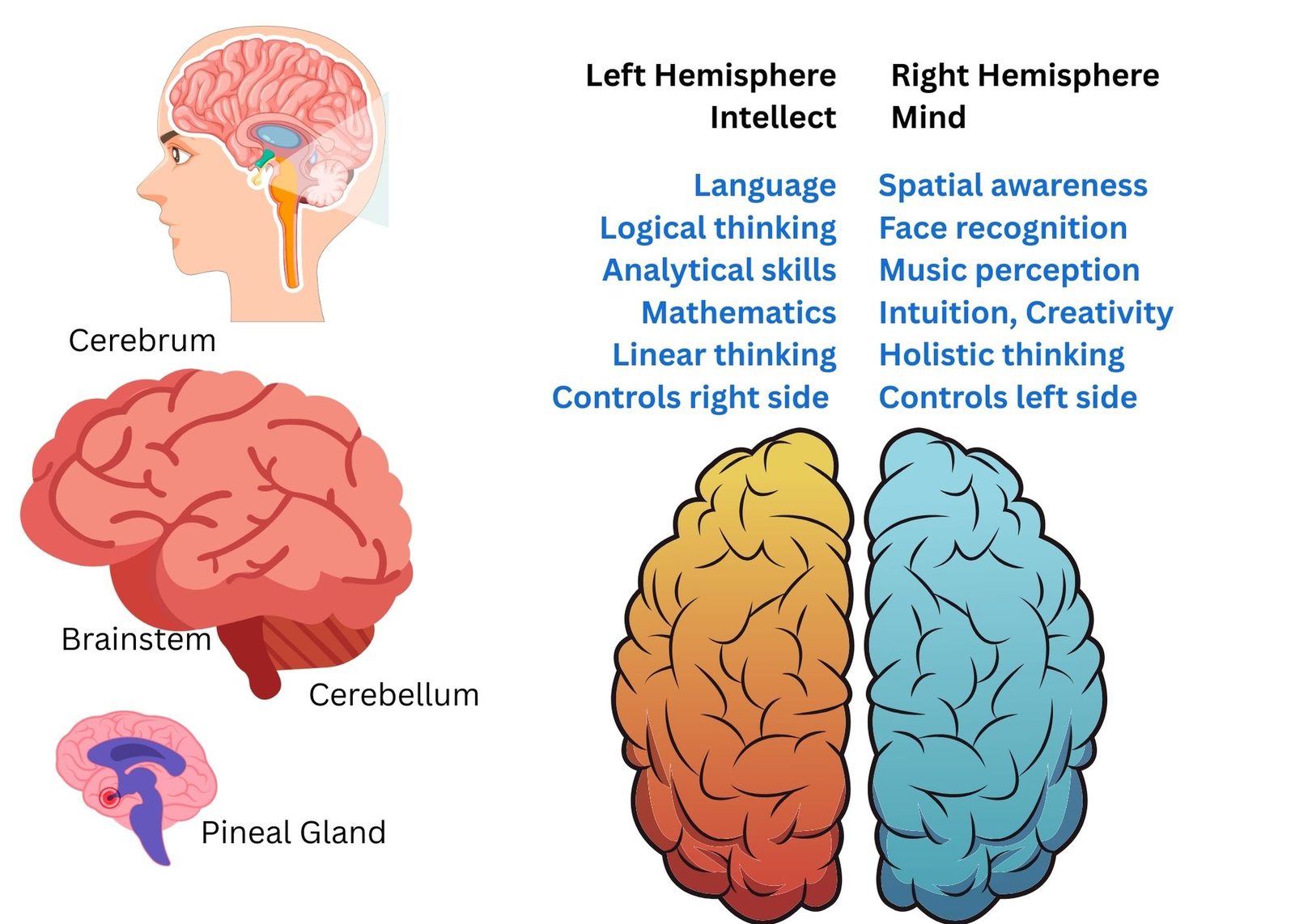
The human brain has three main components: the cerebrum, cerebellum, and brainstem, each with distinct roles. The cerebrum handles thinking, perceiving, planning, and language, and it is split into left and right hemispheres. The left hemisphere is more involved in reasoning, especially logical and language-based tasks, and it matches the Intellect as described above. The right hemisphere seems likely to handle emotions, particularly negative ones, and it corresponds to the Mind. The cerebellum is located at the back and coordinates movements and maintains balance. The brainstem connects to the spinal cord, controlling basic functions like breathing and heartbeat. The brainstem consists of the mid-brain, pons, and medulla oblongata, which are all located below the diencephalon. The pineal gland is located in the diencephalon, a part of the brain that sits above the brainstem. The pineal gland is considered to be the seat of identity.
Traits for the left brain include language, logic, and controlling the right side of the body with the left frontal lobe, specifically managing the right side. Reasoning, especially logical and analytical tasks, is often linked to the left hemisphere, the frontal lobes, which are involved in planning and decision-making. Traits for the right brain include creativity, spatial awareness, and controlling the left side. Emotions involve the limbic system, with the right hemisphere more associated with recognising and expressing emotions, especially negative ones.
The emotions and limbic system can be correlated with creative people while the reasoning ability can correlated to the wise. The nation which regards merit (Guna) as sole means of progression establishes a secular environment. It paves the way for wisdom to be recognised. The wisdom can have indicators in IQ (Intelligence Quotient) and EQ (Emotional Quotient). IQ indicates the scale of intellect and EQ indicates the scale of mind.
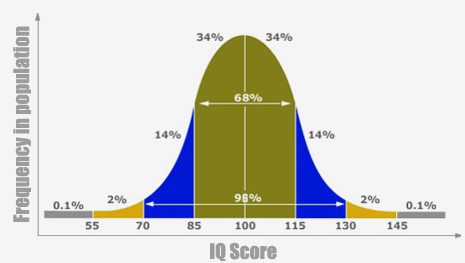
IQ measures cognitive abilities like reasoning and problem-solving, and its scores are standardised to show about 68% of people between 85 and 115, 95% between 70 and 130, and 99.7% between 55 and 145. Research suggests IQ scores in the general population follow a normal distribution with a mean of 100 and a standard deviation of 15. Image Credits
EQ assesses emotional intelligence, including understanding and managing emotions, and follows a similar distribution based on the EQ-i test. The scores measured by the Bar-On Emotional Quotient Inventory (EQ-i) also follow a normal distribution with a mean of 100 and a standard deviation of 15. Both distributions can be visualised as bell-shaped curves, with most people scoring near the average and fewer at the extremes, implying EQ scores are normed similarly to IQ.
This similarity is exceptional. This alignment is crucial for understanding how both cognitive and emotional abilities are distributed, with implications for selection of leaders. We need certain capabilities in leaders such as vision, creativity, capability to understand reality and ability to find solution, rising above narrow interests. This would repreasent leadership capability.
Capabilities and IQ- Higher IQ is associated with enhanced cognitive abilities:
IQ 115-130 (14%): These individuals are 1 to 2 SDS above the mean, excelling in reasoning and problem-solving compared to the average (IQ 100) or below-average (IQ < 115) population. They are more adept at understanding reality and finding solutions.
IQ 130-145 (2%): At 2 to 3 SDs above the mean, these individuals are in the top 2.5% (since IQ > 130 is ~2.28%), with exceptional cognitive skills, making them highly likely to be innovative and visionary.
For cognitive-heavy capabilities, the likelihood increases with IQ. Those below 115 (84%) include the average and below-average, where such skills are less pronounced.
Capabilities and EQ - Higher EQ enhances emotional and social competencies:
EQ 115-130 (14%): These individuals have above-average emotional intelligence, improving their ability to rise above narrow interests and lead effectively.
EQ 130-145 (2%): In the top percentile, they possess superior empathy and emotional regulation, strongly supporting leadership capabilities.
Those with EQ below 115 are less likely to excel in emotionally driven capabilities compared to those higher groups.
Combined Influence of both IQ and EQ - Since the capabilities span cognitive and emotional domains, individuals with high scores in both IQ and EQ are optimally positioned. Assuming independence between IQ and EQ for simplicity:
Both IQ and EQ > 115: Probability ≈ 0.1587 × 0.1587 ≈ 2.52% of the population. Their combined strengths amplify all listed capabilities.
Both IQ and EQ 115-130: Probability ≈ 0.14 × 0.14 ≈ 1.96%.
Both IQ and EQ 130-145: Probability ≈ 0.02 × 0.02 ≈ 0.04%.
The "lower population" (IQ < 115 and/or EQ < 115) constitutes the majority (~84% if considering either metric), with average or below-average scores (e.g., mean IQ or EQ ≈ 95.7 for those below 115), reducing their likelihood of excelling in these areas.
To compare and know the likelihood of leadership capability, we need to rely on the logical premise that higher scores enhance relevant skills.
Cognitive Capabilities (e.g., innovation, problem-solving): Individuals with IQ > 115, especially 130-145, outperform those below 115 due to stronger reasoning and creativity. The top 2% (130-145) are particularly exceptional, as rare cognitive talents often reside in the upper tail.
Emotional Capabilities (e.g., leadership, empathy): Those with EQ > 115, especially 130-145, surpass those below 115, leveraging superior emotional intelligence.
Mixed Capabilities (e.g., visionary): Combining high IQ and EQ (e.g., both > 115) yields a synergistic effect, far exceeding the lower group’s capacity.
Individuals in the higher IQ and EQ ranges (115-130 and 130-145), representing 14% and 2% of the population respectively, are significantly more likely to exhibit capabilities like being visionary, innovative, understanding reality, finding solutions, rising above narrow interests, and leadership compared to the rest of the population with lower scores (below 115, ~84%). This stems from their advanced cognitive and emotional abilities, which align directly with the demands of these capabilities. While exact probabilities require empirical data, the trend is clear: the higher the IQ and EQ, the greater the likelihood, with the 130-145 group likely excelling most due to their rarity and exceptional scores. Thus, people in these higher ranges are much more likely to possess these capabilities compared to those with lower IQ and EQ.
Reimagining India’s Parliamentary System for Rational Governance
For a nation to be governed by reason, its laws must emerge from rigorous research and reflection, crafted by individuals of exceptional intellect and experience who prioritise the collective good over personal or regional interests. In India’s current parliamentary democracy, such individuals are scarce. Parliamentarians, tasked with lawmaking, often delegate this duty to bureaucrats while engaging in executive functions. This blurring of roles undermines democratic principles. There is a need for a reformed parliamentary system inspired by the separation of powers and human physiological analogies, where mature, accomplished individuals serve as parliamentarians, ensuring rational, research-driven governance.
The existing system in India deviates from the ideal of rational governance due to structural flaws that compromise the separation of powers and accountability. In India, bureaucrats frequently draft legislation, a responsibility constitutionally assigned to parliamentarians. This overreach violates the separation of powers, a foundational democratic principle articulated by Montesquieu (1748), which assigns distinct roles to the legislature, executive, and judiciary. When bureaucrats assume law drafting functions, they lack the democratic mandate and public perspective, reducing the quality and legitimacy of laws. Meanwhile, parliamentarians focus on execution, further blurring functional boundaries and weakening accountability.
The Members of Parliament Local Area Development Scheme (MPLADS) exemplifies another systemic flaw. Intended to fund local development, these resources are often misused or inefficiently allocated due to inadequate oversight (PRS Legislative Research, 2019). By directly managing these funds, parliamentarians encroach on executive duties, undermining the separation of powers. Rather than designing robust systems to ensure accountability, they opt for shortcuts, eroding democratic integrity and diverting focus from their primary legislative role.
The proposed system rests on two key principles: the separation of powers and an analogy to human physiology. Montesquieu’s (1748) doctrine of separation of powers divides governance into legislative, executive, and judicial branches to prevent authoritarianism. In human physiology, this mirrors the specialisation of organs, each performing distinct functions under the brain’s coordination. The parliament, as the legislative branch, should focus on reasoning and policy making, while the executive implements policies, and the judiciary ensures justice. This interplay, guided by a unifying authority, ensures harmony and efficiency.
The human body offers a metaphor for governance: the parliament represents the intellect (left hemisphere), the legislative branch embodies the mind and emotions (right hemisphere), and the President, as the ego or identity, resolves conflicts between reason and emotion. A secretariat, akin to the corpus callosum connecting the brain’s hemispheres, facilitates coordination. This analogy underscores the need for specialised roles and balanced decision-making in governance.
The Proposed Parliamentary System
The proposed system reimagines the parliament as a body of mature, accomplished individuals dedicated to rational governance.
Selection of Parliamentarians. Parliamentarians would be selected, not elected, to prioritise merit over populism. This ensures a parliament of seasoned intellectuals and veterans committed to national excellence. Candidates must:
Have excelled in fields such as administration, military, management, or research.
Be over 50 years old, having completed family responsibilities and entered the Vanaprastha stage of life (renunciation for the greater good, per Indian tradition).
Be chosen by the Election and Selection Commission of India, operating under the President’s oversight.
Training and Role. Selected individuals would undergo rigorous training in Indian philosophy, Economics, Political science, Law, Sociology, Public administration, History and Traditional Indian knowledge systems. Initially, they would serve as research associates under supervision, progressing to full-time parliamentarians. Their duties include commissioning research, presenting papers, and designing policies tailored to regional needs. Unlike uniform policies that ignore India’s diversity, this approach ensures solutions reflect local cultures, geographies, and challenges, with states able to request specific interventions. The parliament would operate year-round to maintain continuity and responsiveness.
Parliamentary Functions. This centralised control ensures coherence across critical functions, reinforcing the parliament’s role as the nation’s intellectual core. The parliament would wield significant authority, including:
Budget Control: Overseeing the national budget, aligned with long-term financial goals approved by the President.
Institutional Oversight: Managing key national bodies, such as:
National security and intelligence agencies
Internal security forces
Scientific and research institutions
Audit and vigilance agencies
Ethical Governance and Accountability. Ethical conduct and accountability are non-negotiable in the proposed system. Parliamentarians must embody the adage “Caesar’s wife must be above suspicion” (Plutarch, Life of Caesar), meaning their integrity must be beyond reproach. Tainted or corrupt individuals would be disqualified, with consequences extending to their families, reflecting the societal impact of corruption. This collective accountability mirrors traditional Indian values, where personal honour affects familial status.
Compensation and Tenure. Parliamentarians would receive salaries equivalent to the highest bureaucratic pay scales, serving until age 75 or retirement. Exceptional individuals could be promoted to the Presidential Secretariat, ensuring continuity of expertise and rewarding merit.
Coordination and Conflict Resolution. The system emphasises coordination and balanced decision-making. A secretariat would act as a coordinating agency between the parliament, executive, and state representatives, akin to the brain’s corpus callosum. State representatives, primarily based in their regions, could attend parliament when needed, ensuring local voices inform national policy. Conflicts between the parliament (reason) and the legislative (emotion) would be arbitrated by the President, representing the nation’s identity or ego. This mirrors human decision-making, where the ego balances intellect and emotion, ensuring decisions serve the greater good.
India’s current parliamentary system, marred by bureaucratic overreach and the misuse of constituency funds, falls short of rational governance. The proposed system addresses these flaws by enforcing a strict separation of powers, selecting merit-based parliamentarians, and prioritising research-driven, region-specific laws. By integrating human physiological analogies and Indian philosophical principles like Vanaprastha, this model offers a visionary path toward ethical, effective governance. Implementation would require constitutional reform and a shift from populism to meritocracy, but the result could be a parliament that truly embodies the nation’s intellectual and moral aspirations.