Chapter 16 · Plato's Republic
Book 5-7
An Overview of Book 5
Book 5 continues the construction of the ideal city by addressing two major issues: the role of women and the nature of the rulers.
The book begins with Glaucon expressing surprise at the earlier suggestion that women can be guardians, the elite class of rulers and warriors. Socrates defends this by arguing that there is no inherent difference in ability between men and women that would disqualify women from this role. He posits that the only differences are physical, such as strength, which are not relevant to the guardian's primary duties of ruling and defending the state. Therefore, women should receive the same education as men, including physical and intellectual training, and be selected based on merit, not gender.
Socrates then introduces the concept of the philosopher-king, asserting that the ideal rulers are those who are lovers of wisdom and can understand the eternal Forms, which are the ultimate truths. He argues that only those who have knowledge of the Form of the Good, the highest Form, are fit to govern, as they can make decisions based on what is truly good, rather than on personal interests, popular opinion, or transient desires. This leads to the famous statement that "until philosophers are kings, or kings are philosophers, there will be no rest from the evils of the state," emphasising the necessity of wise leadership.
To ensure that the guardians, including the philosopher-kings, are not corrupted by personal interests, Socrates proposes that they should live in a communal arrangement. This means they should not have private property or individual families. Instead, they should share wives and children, and their needs should be provided by the state. This communal living is intended to make the guardians' loyalty absolute to the state as a whole, preventing any conflict of interest. Socrates suggests that the state should regulate marriages among the guardians to ensure that the best are bred with the best, much like in a carefully managed animal breeding program, to produce the most talented and capable offspring. Children should be raised in common, without knowing their biological parents, to foster a sense of unity and prevent divided loyalties.
The discussion also includes practical implications, such as the idea that both men and women can participate in the same activities and hold the same positions if they have the required abilities. This extends to physical training and governance, emphasising that the ideal state should be based on meritocracy, not on traditional gender roles or other arbitrary distinctions.
The key lesson from the dialogue emerges, the roles should be assigned based on ability and merit, not on gender or other arbitrary characteristics. This lesson underscores the importance of fairness in leadership selection, ensuring that the best individuals, regardless of gender, govern the state.
An overview of Book 6
Book 6 continues the construction of the ideal city by delving into the nature, education, and qualifications of these philosopher-kings. This book is pivotal for its discussion of the Form of the Good, the line analogy, and the rigorous educational process for philosopher-kings, which have influenced subsequent philosophical and political thought.
The book begins with Socrates emphasising the importance of the Form of the Good as the highest and most important object of knowledge. He argues that it is the source of all goodness and truth, analogous to the sun in the visible world, which provides light and life. The Form of the Good illuminates the realm of Ideas and makes knowledge possible, giving truth to the things known and the power to know them. Socrates uses the analogy of the sun to explain this: just as the sun is not itself sight but the cause of sight, the Form of the Good is not itself knowledge but the cause of knowledge.
To illustrate the hierarchy of knowledge and reality, Socrates presents the line analogy. This divides the world into four levels, representing different degrees of being and knowing:
Images: Shadows, reflections, and other representations, which are the lowest level of reality, known through imagination.
Physical Objects: The actual objects that cast shadows, known through belief or opinion.
Mathematical Truths: Abstract concepts and reasoning about physical objects, such as geometry, are known through thought but are still based on assumptions.
The Forms: The eternal, unchanging, perfect Ideas, such as the Form of the Good, known through understanding or intelligence, representing the highest level of reality.
This analogy helps to distinguish between opinion (based on the visible world, including images and physical objects) and knowledge (based on the intellectual world, including mathematical truths and the Forms). Philosophers, by understanding the Forms, have true knowledge, while others are limited to opinion based on sensory experience.
The education of the philosopher-kings is a rigorous and lengthy process, designed to lead them from the world of becoming to the world of being, ultimately to the contemplation of the Form of the Good. Socrates outlines the curriculum, which includes:
Arithmetic and Geometry: To train the mind in abstract thinking and prepare it for understanding eternal truths.
Astronomy and Music: To appreciate the harmony and order in the universe, aiding in the comprehension of the Forms.
Dialectic: The study of the Forms through philosophical reasoning, which is the highest stage of education, allowing the philosopher to grasp the Form of the Good.
This education is not quick; Socrates suggests it starts in youth and continues until the philosopher is around 50 years old, with various stages of learning and practical experience, emphasising the extensive time commitment required.
Philosophers are described as lovers of truth and wisdom, who are naturally inclined to seek knowledge of the Forms. However, in society, they are often misunderstood and seen as impractical or eccentric. Glaucon raises concerns about the practicality of having philosopher-kings, noting that philosophers are typically not ambitious for power and that the idea might be unrealistic. Socrates counters that the problem lies in the corrupted state of existing societies, not in the concept itself. He argues that if philosophers are properly trained and the state is structured correctly, philosopher-kings can indeed exist and rule effectively, though they might need to be compelled to rule, as they would naturally prefer the contemplative life.
The key lessons that emerge from the dialogue are the following.
Need for Philosophical Leadership: They are the only ones fit to rule due to their understanding of truth. This lesson challenges conventional notions of leadership, suggesting that the best rulers are those driven by duty rather than ambition.
Rigorous Education for Leaders: The best leaders have deep wisdom and understanding of truth, as exemplified by their knowledge of the Form of the Good. The emphasis is on intellectual and moral qualifications over popularity or charisma. Leadership requires a comprehensive and rigorous education that encompasses both theoretical knowledge (mathematics, sciences) and practical wisdom (dialectic). This long-term process ensures that rulers are well-prepared to govern, emphasising the importance of lifelong learning and maturation.
An Overview of Book 7
Book 7 continues the construction of the ideal city by delving into the philosopher's journey and their duty to govern. The dialogue is primarily between Socrates and Glaucon, with Adeimantus occasionally participating, as they seek to refine the vision of the perfect state and its leadership. This book is pivotal for its inclusion of the "Allegory of the Cave," a famous metaphor for the process of enlightenment and the philosopher's responsibility.
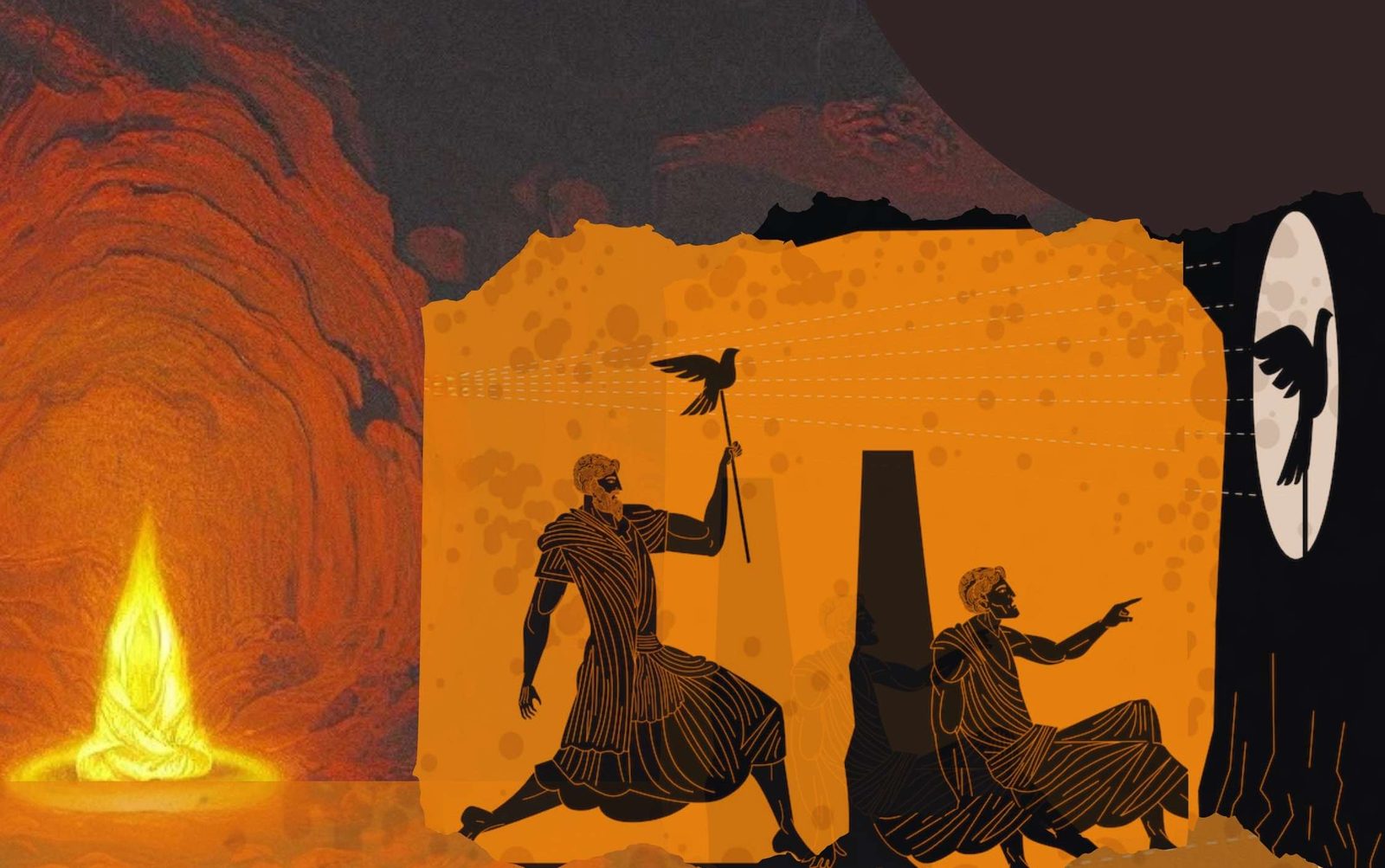
The book opens with Socrates presenting the "Allegory of the Cave," a vivid illustration of the philosopher's journey from ignorance to enlightenment, building on the "Divided Line" analogy from Book 6. In the allegory, prisoners are chained in a cave, facing a blank wall, and can only see shadows cast by objects passing in front of a fire behind them. These shadows are all they know, and they believe them to be reality. One prisoner is freed and forced to turn around, initially blinded by the fire, but eventually sees the objects casting the shadows. He is then led out of the cave into the sunlight, where he sees the real world, including the sun, which represents the Form of the Good, the ultimate truth. Upon returning to the cave, he struggles to see the shadows again and faces resistance from the other prisoners, who think he has been corrupted and don't believe his story.
The allegory serves multiple purposes. It illustrates the distinction between the world of appearances (the cave and shadows) and the world of true reality (the outside world and the Forms). It also highlights the process of education as a painful and challenging journey from ignorance to knowledge, requiring effort and guidance. Finally, it underscores the philosopher's duty to return to society and use his knowledge for the common good, despite the difficulties of being misunderstood or rejected by those still in the cave.
Following the allegory, Socrates discusses the practical steps for implementing the philosopher-king system, building on the educational curriculum outlined in Book 6. Potential philosopher-kings are selected from a young age based on their natural abilities and temperament. Their education includes:
Early Stages: Physical training and basic education in music to develop the body and soul, starting from childhood.
Mathematical Studies: From around age 20 to 30, they study arithmetic, geometry, astronomy, and music, to train the mind in abstract thinking and understand the harmony of the universe.
Dialectic: From age 30 to 35, they engage in philosophical reasoning, studying the Forms, intending to understand the Form of the Good.
Practical Experience: From 35 to 50, they are tested in practical affairs, governing and leading, to prove their fitness for rule.
Final Stage: After age 50, they go back to the academy, learn rhetoric and other advanced knowledge and those who have excelled become philosopher-kings, ruling with wisdom and justice.
This long-term process ensures that only the most qualified and dedicated individuals become rulers, emphasising the commitment required for leadership.
Socrates argues that philosopher-kings, having achieved enlightenment, must be compelled to return to the "cave"—the world of ordinary people—and govern, despite their natural inclination to remain in the realm of pure contemplation. This is because they are the only ones fit to rule, given their understanding of truth and the good, and their duty is to the state, not to their personal preferences. Glaucon raises concerns about the practicality, noting that philosophers are often seen as impractical or eccentric, but Socrates counters that the problem lies in the corrupted state of existing societies, not in the concept itself.
From the dialogue, the following lessons emerge.
Responsibility of the Enlightened. Philosophers have a moral obligation to return to society and use their knowledge to improve it, even if they face resistance, emphasising the duty of the educated to serve the greater good.
Leadership Requires Deep Understanding: True leaders must have a profound understanding of ethics and truth, not just practical skills or popularity, to govern justly and effectively, underscoring the need for philosophical education in governance.